Drywall Repair in Hales Corners, WI
Tea-colored rings from ice backing up at the eaves, basement walls that drank up a flood, popped nails, a doorknob-sized crater in the hallway: put right, texture copied, and finished so the seam blends into fresh paint.
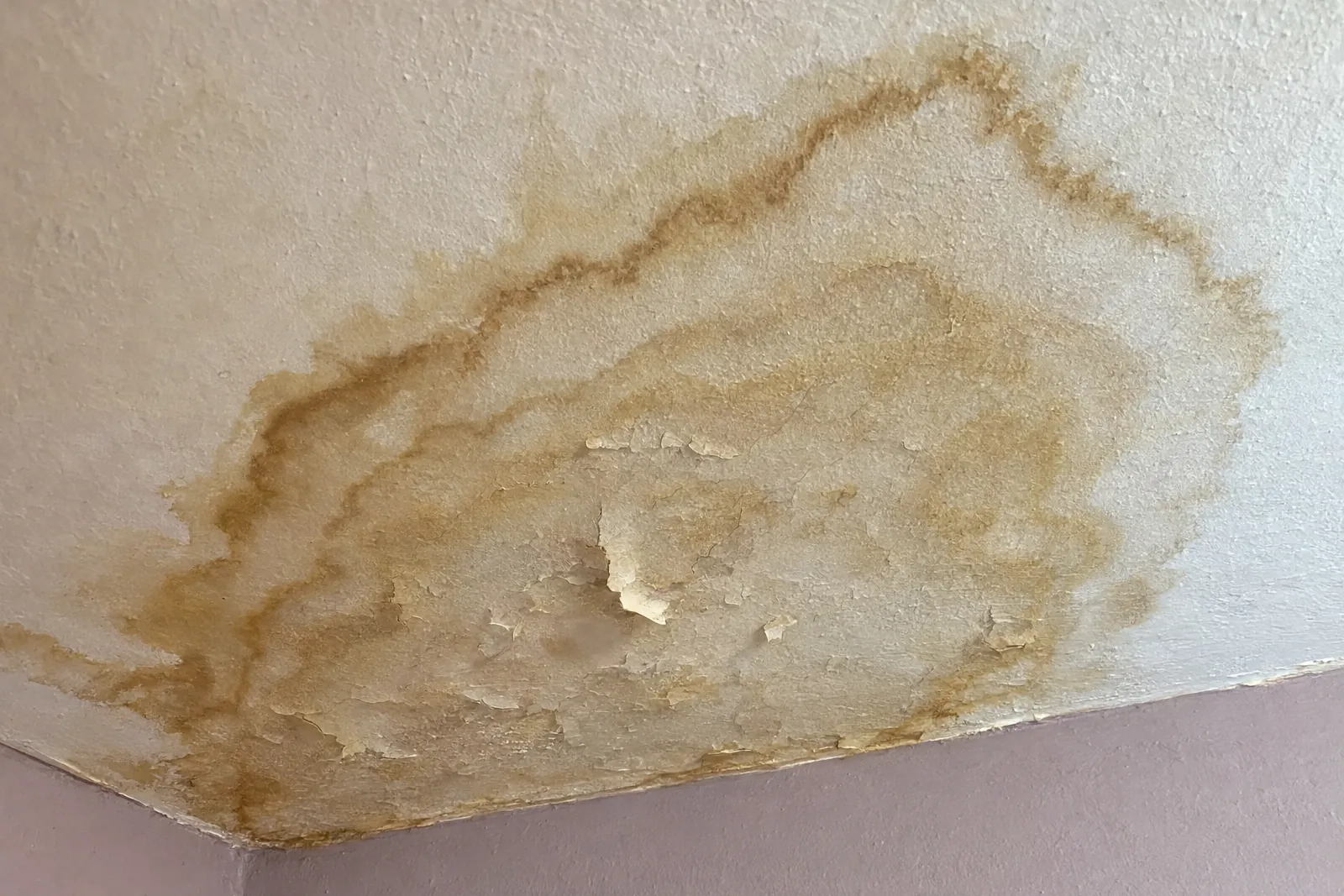
It tends to start on a February morning, with a ring above the bedroom window that wasn't there at bedtime. Phone us about it, or send over a snapshot by text; the repair gets priced before anything is touched.
What happens to your floors and furniture while the wall gets sanded?
Picture the hallway outside a bedroom on the morning a repair begins: the runner rolled and stood in a corner, a plastic curtain taped across the doorway, the cold-air return papered over. That is what careful drywall work looks like long before the first knife of mud. Sanding powder is so fine that the furnace will happily carry it from the back bedroom to the front porch, so sealing the room off comes first.
Canvas or heavy paper goes down along the wall, never slippery plastic, its edges tucked flat so nobody catches a toe. Whatever furniture stays behind is huddled toward the center of the room under its own cloth. Registers near the work get shut and masked, and beneath a ceiling repair the light fixture is bagged. Plenty of pros hook the sander to a vacuum, and stray powder gets lifted with a HEPA vacuum, because a broom only throws it back into the air.
Two things help from your end. Take down the pictures and empty the shelves on the damaged wall, and if there's something you'd rather nobody shifted, a piano or a fish tank, say so on the first phone call. Asking how dust will be handled is fair game too; a straight, specific answer there usually means the rest has been thought through.
Water came through the ceiling. What should happen next, and in what order?
A thaw can turn a clean ceiling into a stained one between lunch and supper. When it does, getting the steps in the right sequence beats rushing.
Kill the power, then clear the floor
When the drywall overhead is swollen or dripping, walk to the breaker panel before anything else and switch off whichever circuit serves the fixture or fan beside the swelling. With that circuit dead, shoo people and pets away from underneath and park a bucket below. Water and a ceiling fixture should never meet while the wiring is live.
Find where it's coming from
Drywall money spent while water still drips is spent twice. Over a top-floor room during a Hales Corners winter, the prime suspect is ice backed up along the eaves; downstairs it's more often seepage through the foundation, a sump that gave out, or a supply line. So a roofer or plumber may need to come first, ahead of anyone with a taping knife.
Give it drying time
Soggy board, soaked batts and damp framing all need time. UMN Extension, the University of Minnesota's outreach arm, says plainly in its ice-dam guidance that interior repairs wait until ceilings and walls are dry. A dehumidifier and a couple of fans speed that along.
Measure first, cut second
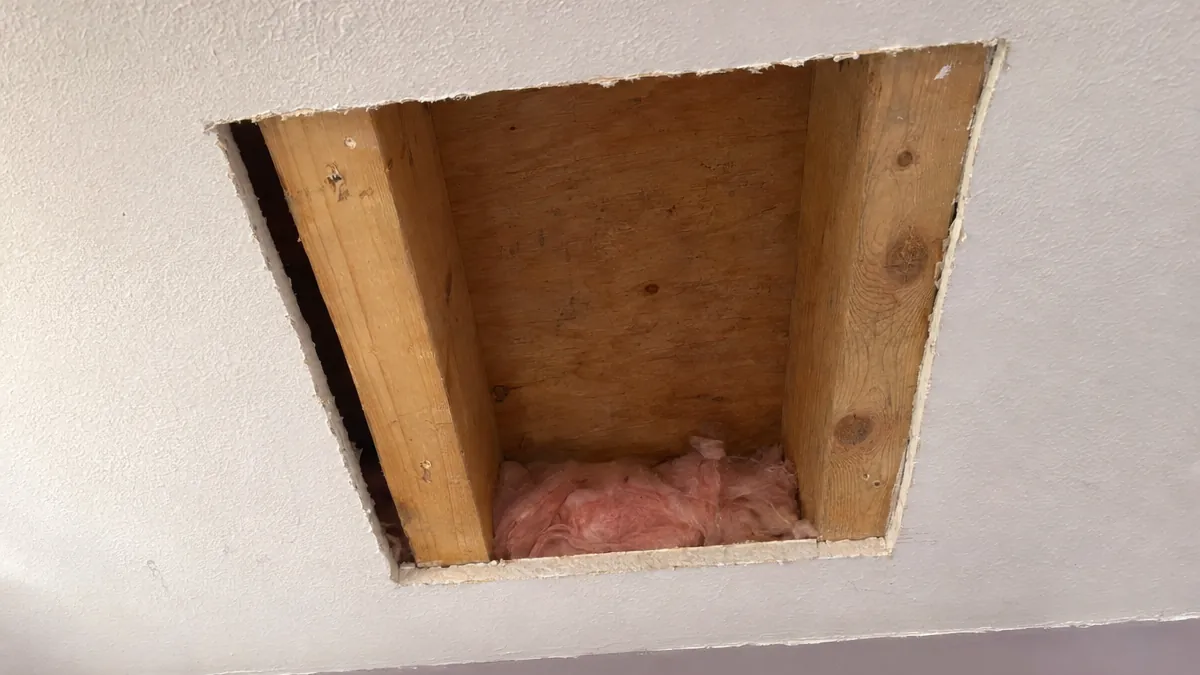
A moisture meter picks up what eyes miss. Gypsum that meters dry and still feels solid can frequently be sealed and refinished where it hangs. Gypsum that crumbles, droops or smells musty gets cut back beyond the stain's outer edge into dry material and replaced, which is the heart of putting an ice-dam ceiling back together.
Which of the four sounds like your wall?
Here are the four kinds of drywall repair this site arranges in Hales Corners, listed roughly in the order a Wisconsin winter and spring deal them out. Pick the row that describes your wall best.
- Ice-dam ceiling leak repairTan rings and soft patches near the outer walls of upstairs rooms, after snowmelt backs up behind a frozen eave.
- Basement water damageLower-level walls that wicked up a seep, a sump failure or a burst line, opened up, dried and rebuilt.
- Nail pop and crack repairLittle round bumps marching along the studs, lines creeping from door corners, seams that split each heating season.
- Drywall hole patchingDoorknob craters, anchor holes, battered outside corners and gaps where an old fixture or cable once ran.
How long is the room out of use, and how will the wall look afterward?
Remember the last time a bedroom got painted: the smell, the drop cloths, a day or two before the dresser went back against the wall. Drywall repair keeps a similar calendar, and joint compound's drying time is what writes it.
Even a modest patch wants two or three coats, each dried and sanded before the next. Quick-set powder compound narrows the wait between early coats but never removes it. So a small repair commonly stretches over two or three days, the room usable between coats, and a replaced ceiling section runs longer, longer still in a chilly house where mud cures slowly.
Dust: expect a light film near the work, not a coating from attic to basement, provided the area is masked and the sanding is vacuumed. Paint: every patch gets primer, and whether finish paint belongs in the job is worth settling as the quote takes shape. Appearance: a widely feathered patch on a flat wall becomes very hard to find from across the room once painted. Low winter sun skimming along that wall may still betray a faint edge, and an honest pro will say so up front instead of promising otherwise. More plain answers like these are collected in the drywall guides for Hales Corners homes.
Do the newer houses around here crack too?
Most of the village is older housing, though not all of it. Census Bureau estimates put 491 of today's village homes in the 1990-and-later columns, and newer houses carry complaints of their own, almost all of them tracing back to lumber giving up its moisture.
Fresh studs and joists shrink through their first few winters of forced-air heat. As they shrink, they let go of the screws and nails holding the board, and the mud over each fastener gets shoved outward into the small round blisters called nail pops. That same shrinking opens hairlines at the upper corners of doors and windows, where the header framing carries the most strain.
When the corner gap comes back each January
Truss uplift is the other culprit. Under a trussed roof, each truss's bottom chord sits snug and dry beneath attic insulation while its top chords, exposed to cold attic air, soak up moisture and grow slightly longer. Come winter the truss bows upward, lifting the ceiling along with it, so a gap appears where ceiling meets an interior partition; by summer it settles back. Stuffing that gap with stiff mud fails each January. The usual cure lets the ceiling edge float, clipped to the wall framing instead of the truss, with a flexible bead or a strip of trim at the corner. If yours gapes every winter, bring it up on the phone, and there's more about it under cracks and popped nails.
Why can a repair still be seen through fresh paint?
You've likely noticed it in somebody's living room: a newly painted wall, and yet when afternoon light slants in a dull rectangle floats right where the old hole was. Painters call that flashing. Bare mud is thirstier than the painted surface beside it, so the topcoat dries flatter or shinier over the repair.
What prevents it is a coat of primer across the repaired area ahead of any finish paint: a drywall primer on ordinary patches, and over a ceiling ring a stain-blocking primer formulated to keep that brown halo from creeping into the new coat. Sheen comes next. Eggshell and satin give a patch away far more readily than flat ceiling white does, which is why a wall with some shine often gets repainted corner to corner rather than dabbed in one spot.
On who paints: some people like rolling the last coat themselves, others want the wall handed back finished. Mention your preference when asking for the quote. And if a leftover can from that room sits on a basement shelf, keep it, since whatever is printed on its lid saves everyone some guessing about color and sheen.
Is that plaster or drywall behind your paint, and does it matter?
Rap your knuckles on a wall in an older house and listen. Plaster answers hard and dense, almost like stone. Half-inch drywall gives a hollow knock between studs and a dull thud over them. Homes from the 1940s and early 1950s were often plastered, frequently over gypsum lath, before drywall took over. That matters, because each one is mended its own way: loose plaster gets reattached and built back up in layers of setting-type mud, whereas drywall gets fresh board, tape and finish coats.
Board
Standard half-inch panels cover most walls. Ceilings often get thicker or sag-resistant panels, any wall separating living space from an attached garage gets fire-resistant Type X, and bathrooms and lower levels get moisture- or mold-resistant panels. A replacement piece matches the thickness already there so it lies flush.
Compound
Powdered setting compound, stirred up with water, sets by chemistry rather than drying, and handles deep fills and bedding tape. Premixed all-purpose and lightweight muds dry by evaporation and sand more easily, which suits final coats.
Texture
Smooth, orange peel, knockdown, swirl and popcorn all turn up on walls and ceilings around here. Copying one means reproducing the pattern, the spray pressure or roller nap, and the build, usually rehearsed on a scrap panel first. Older popcorn ceilings come with a caution attached: the texture may contain asbestos, which only a lab test of a small chip can confirm, and that test comes first.
Where else besides the village can a repair be arranged?
The village is the hub of this short list, and every place on it is covered.
- Greenfield Across the village's northern edge; Hales Corners was legally part of it until 1952.
- Greendale The neighbor to the east, laid out in the 1930s as a federal Greenbelt town.
- Franklin To the south, where part of Whitnall Park crosses into the city.
- New Berlin and Muskego Over the Waukesha County line on the west side.
- West Allis A short drive to the north-northeast, home of State Fair Park.
Each town also gets a few sentences of its own on the Hales Corners service area page, next to a map.
Small, medium or large: what shifts as a repair grows?
Small
A few popped nails, anchor holes, a hairline crack or a dent no bigger than a coin. Filled, given two or three thin coats, then primed. Most of the clock goes to letting mud cure.
Medium
A doorknob hole, a cracked corner bead, or a stain where the board underneath is still sound. A backed patch or new bead, three coats, texture and primer, spread over two days or so.
Large
A water-damaged ceiling section, a lower-level wall opened up after flooding, anything with wet insulation behind it. Opened to the framing, dried, new board, tape, three coats, texture and primer, often after another trade has dealt with the water.
Inch Calculator's drywall repair cost guide, a national source last updated October 2023, pegs a small repair near $60 to $200, one large repair or a batch of small ones near $300 to $900, and hourly pro rates around $60 to $100. Nothing about those numbers is specific to Hales Corners. Here, a quote mostly swings on how big the damage is and how high it sits, whether the gypsum behind a stain is wet, how fussy the texture is, if paint is included, and how many separate days the drying spreads the job across.
What do the houses in Hales Corners have in common?
Stand where Janesville Road meets Highway 100 and it takes some imagination to see the plank toll road that crossed here in 1848. The houses tell the later chapters better. The Census Bureau's survey figures for 2020–2024 put the village's housing at 3,311 homes, and 1,173 of those were built in the 1950s, more than in any other decade. Fold in the 1940s and 1960s and the tally climbs to 1,919, comfortably over half of what stands today. Hales Corners became its own village in January 1952, squarely inside that building wave. About 2,034 of those homes are stand-alone, one-unit houses.
| Built | Homes |
|---|---|
| 1939 or earlier | 248 |
| 1940s | 121 |
| 1950s | 1,173 |
| 1960s | 625 |
| 1970s | 355 |
| 1980s | 298 |
| 1990s | 213 |
| 2000s | 210 |
| 2010s | 68 |
| 2020 or later | 0 |
| All homes | 3,311 |
For walls, that history adds up to a lot of houses that have weathered some seventy Wisconsin winters, often with plaster or early drywall under several generations of paint, framing that finished settling long ago, and a crack that reappears at the same door corner. Focus on Energy, the state's utility energy program, recommends R-49 or more of insulation for Wisconsin attics; an attic short of that lets warmth reach the roof deck, and a warm roof deck is where ice dams get their start. Repairs in houses like these lean on copying what's already there rather than starting over.
Do you own a rental here? How do repairs fit around a tenant?
Picture the week between one lease running out and the next one starting: carpets to shampoo, a living room wall peppered with anchor holes where a wall-mounted TV used to be, a scuffed outside corner where a sofa went down the hall. Turnover week is the easiest window for drywall, since nobody has to live around the drying days.
With several rooms needing attention, send photos of each and ask for one quote covering the lot; bundling usually beats booking every wall separately. Explain how the unit gets opened, a lockbox you control or you meeting the pro at the door, and say if paint should be included or if you have your own painter lined up for after.
If someone still lives there, give whatever notice your lease calls for, and warn them the room will be masked off and out of use for parts of two or three days on anything larger than a small patch. A ring on a rental ceiling deserves tracing to its source before it's patched, too, so the next occupant isn't greeted by the same stain in March.
Got a stain, a crack or a hole you've been putting off?
Describe it over the phone or snap a picture and send it. The repair is priced before any work starts.
Your call lands with us; after that, the pro who'd take on the job rings back to talk through sizes, textures and a price.
How it works